
1 Million Clicks, No Growth? Fix Your Marketing Funnel
One million clicks do not guarantee growth. Learn how traffic quality, conversion, attribution, and acquisition economics shape performance marketing results.

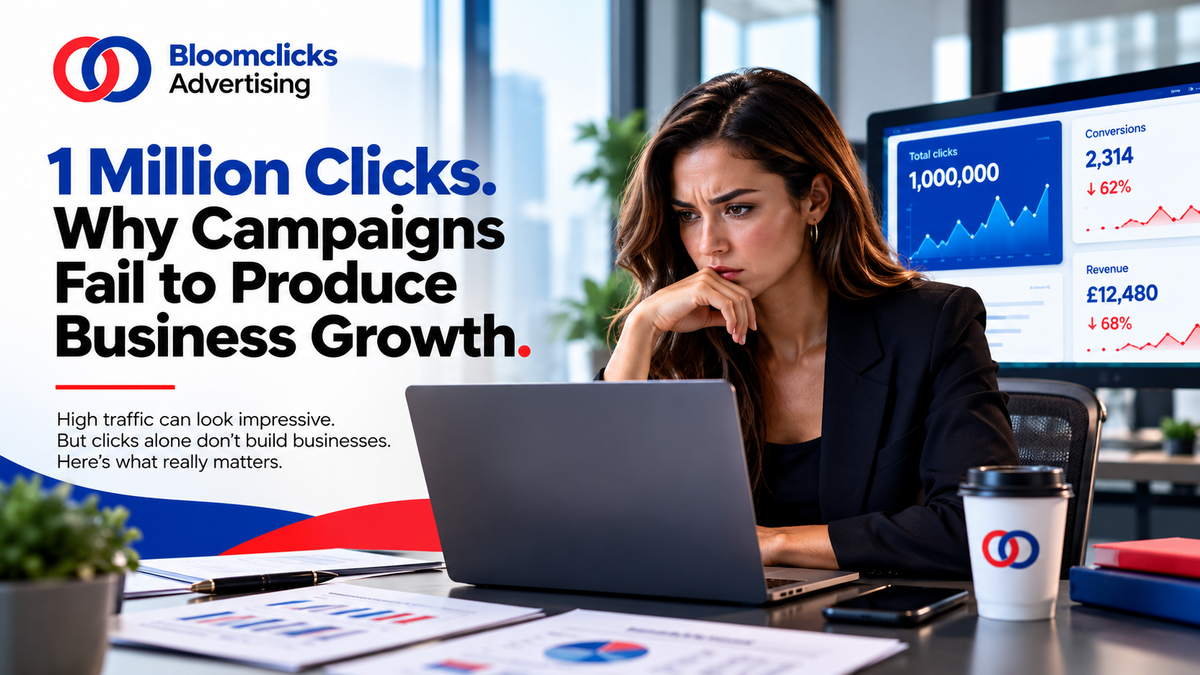
Your Campaign Generated 1 Million Clicks. Why Didn’t Your Business Grow?
Digital marketing dashboards can make activity easy to see. Impressions, clicks, click-through rates, and cost per click are useful metrics, but they answer only part of the business question.
The more important question is this:
What happened after people clicked, and did those actions contribute to the outcome the business actually needed?
Consider an illustrative scenario: a company attracts one million clicks but sees disappointing sales, inconsistent lead quality, or little improvement in profitability. The answer is not automatically to buy more traffic. The company first needs to identify where the journey is breaking down and whether its measurement is reliable.
Here are six areas to investigate.
1. Traffic volume is not traffic quality
Not every visitor arrives with the same level of intent, need, or fit.
A person researching a problem, a person comparing alternatives, and a person ready to purchase may all generate a click, but they represent different opportunities.
Traffic quality can be affected by audience targeting, creative messaging, placement, search intent, referral context, geographic relevance, and the match between the visitor and the offer.
A campaign may also attract people who are curious about the headline but have little interest in the product or service behind it.
What to check:
- Which sources, campaigns, placements, and partner groups bring relevant visitors?
- Which segments produce meaningful actions rather than visits alone?
- Are there unusual patterns in engagement, conversion, or lead validity?
- Does the campaign message accurately represent the offer users encounter after clicking?
Do not label traffic as poor quality based on one metric alone. Compare multiple indicators and, where possible, validate leads or transactions against reliable business records.
2. The landing page may be losing interested visitors
A click is an opportunity to continue the customer journey. It is not a commitment to buy.
Visitors may leave because the page loads slowly, the message does not match the ad, the value proposition is unclear, the form is too demanding, the offer lacks credibility, or the next step is hard to understand.
These are hypotheses to test, not assumptions to make without evidence.
What to check:
- Does the page deliver what the ad or referral promised?
- Is the main value proposition clear within seconds?
- Does the page work well on mobile devices?
- Is the next action obvious and proportionate to the visitor’s intent?
- At which step do visitors abandon the journey?
Use funnel data, usability testing, customer feedback, and controlled experiments to identify friction. Avoid redesigning everything at once; targeted changes make it easier to learn what actually improves results.
 Adesanmi Ajayi

3. You may be measuring the wrong conversion
Not all conversions have the same commercial value.
A button click, content download, newsletter signup, qualified lead, completed purchase, and retained customer are different events. Each may be useful, but should be interpreted according to its purpose.
If a campaign is optimized around a low-value interaction while the business needs qualified sales, the campaign report can look healthy even when commercial results disappoint.
Define the primary conversion before launch. Then distinguish it from supporting events that help explain the journey.
For a lead-generation business, that could mean separating a form submission from a valid lead, a sales-qualified opportunity, and a closed customer. For e-commerce, it could mean separating product views and add-to-cart events from completed, valid transactions.
What to check:
- Is the primary conversion clearly defined?
- Are duplicate, incomplete, or invalid events being counted?
- Can campaign-reported conversions be reconciled with CRM or transaction records?
- Are teams optimizing toward the outcome that matters to the business?
Google’s guidance on conversion measurement similarly recommends defining valuable actions and measuring which campaigns contribute to them. Measurement is most useful when the recorded event reflects the business objective rather than merely an easy-to-count interaction.
4. Attribution can make the picture look different
Customers may interact with multiple marketing touchpoints before converting. They might discover a brand through content, return through search, compare options through a publisher, and eventually purchase through another channel.
Attribution is the method used to assign credit to interactions along that journey. Different attribution approaches can distribute credit differently, so a channel’s reported contribution should not automatically be treated as the complete explanation of why a customer converted.
Attribution is also not the same as incrementality. A channel can receive credit for a conversion without proving that the conversion would not have happened otherwise.
What to check:
- Are campaign tags and tracking parameters consistent?
- Are key conversion events recorded reliably?
- Do platform reports reconcile with internal records within understood tolerances?
- Are teams comparing attribution views when appropriate?
- Can experiments or other credible methods help determine whether a campaign caused additional outcomes?
The objective is not to find a single perfect number. It is to understand what the available evidence supports, where uncertainty remains, and how those limitations should affect budget decisions.
 Adesanmi Ajayi
5. More conversions do not automatically mean better economics
Commercial performance requires a connection between acquisition cost and the value of the outcomes acquired.
Imagine two campaigns. Campaign A produces more leads at a lower cost per lead. Campaign B produces fewer leads, but a larger proportion become paying customers. Without sales conversion, revenue, and cost information, the business cannot confidently conclude which campaign is more valuable.
The relevant measures depend on the business model. They may include cost per qualified lead, customer acquisition cost, conversion to sale, average order value, contribution margin, repeat purchases, retention, and customer lifetime value where sufficient data exists.
An illustrative example
Campaign A generates 1,000 leads at $10 each, for a total lead-generation cost of $10,000. If 2% become customers, it produces 20 customers at a lead-generation cost of $500 per customer.
Campaign B generates 500 leads at $20 each, also for a total cost of $10,000. If 8% become customers, it produces 40 customers at a lead-generation cost of $250 per customer.
In this simplified example, Campaign B produces twice as many customers for the same lead-generation budget, despite its higher cost per lead.
This is not a complete profitability calculation: it excludes other acquisition, sales, service, fulfilment, and operating costs, as well as differences in customer value. It illustrates why an isolated metric can lead to the wrong decision.
6. Scaling before diagnosing can magnify the problem
Increasing spend can increase traffic. But if the underlying problem is poor audience fit, a broken conversion path, unreliable tracking, or weak customer economics, more volume may simply make the problem more expensive.
A disciplined growth process establishes a baseline, checks the measurement, identifies the largest constraint, tests a focused change, and evaluates the outcome before scaling.
A practical sequence is:
- Define the business outcome. Specify what success means: a qualified lead, a completed sale, a profitable customer, or another meaningful result.
- Validate the measurement. Test key events, campaign parameters, duplicate handling, and reconciliation with internal records.
- Segment the traffic. Compare sources, placements, campaigns, devices, audiences, and partner groups where the data supports it.
- Inspect the journey. Find where users drop off between the click and the target outcome.
- Evaluate the economics. Connect spend to qualified outcomes, sales, revenue, and relevant costs.
- Test before scaling. Make a defined change, measure its effect, document the result, and expand only when the evidence supports doing so.
What this means for partnership and performance marketing
Affiliate, publisher, and creator partnerships should be evaluated in the context of the business objective, not simply by the number of clicks or the size of an audience.
Different partners can play different roles. Some may introduce new audiences; others may support consideration, comparison, qualified leads, or completed sales. Their contribution should be evaluated against agreed objectives, reliable tracking, appropriate quality checks, and the economics of the offer.
The right measurement framework also depends on the commercial arrangement. A pay-per-click campaign, a pay-per-lead program, and a revenue-share partnership do not have identical risks or success criteria.
Businesses should define the expected action, the quality requirements, the attribution rules, and the reporting method before scaling a partnership. Clear agreements make it easier to identify what is working and to resolve disputes over performance.
Where Bloomclicks Advertising fits
Bloomclicks Advertising is positioned around revenue acquisition and partnership marketing, bringing together the platform’s advertising, tracking, partner, and campaign-management direction.
The guiding principle behind this direction is straightforward: businesses need to understand more than how much traffic they generate. They need to ask how that traffic relates to meaningful actions, partner performance, and commercial decisions.
The specific reports and capabilities available in a live implementation should always be verified before they are presented as production-ready. No platform can guarantee profitable growth merely by recording clicks, and no dashboard removes the need for sound measurement, business context, and disciplined testing.
The Measurement framework to consider
Set a baseline before launch. Do not invent target numbers or benchmark claims. Establish initial performance from the first two weeks, then set realistic targets based on actual channel reach, audience size, resources, and business objectives.
These are recommended campaign measurement definitions, not a claim that Bloomclicks Advertising already has a fully implemented, unified marketing dashboard.
The question to ask before your next campaign
Before increasing your budget, ask:
Can we explain how our traffic becomes qualified demand, how that demand becomes customers, and whether those customers justify the acquisition cost?
If the answer is unclear, the next step may not be more traffic. It may be better diagnosis.
At Bloomclicks Advertising, we welcome conversations with merchants, advertisers, publishers, affiliates, and creators who want to evaluate their acquisition and partnership-marketing challenges more carefully.
Join the discussion:
Which is the biggest obstacle in your growth funnel: traffic quality, conversion, attribution, or partner performance?
If you are reviewing your acquisition or partner strategy, contact Bloomclicks Advertising to start a practical conversation about your business objectives and measurement needs.
Frequently Asked Questions (FAQs)
1. Do one million clicks guarantee business growth?
No. A high number of clicks does not automatically translate into leads, customers, revenue, or profit. Business growth depends on the quality and relevance of the traffic, the effectiveness of the conversion journey, accurate measurement, and the economics of customer acquisition.
2. Why do marketing campaigns generate traffic but fail to convert?
Several factors can contribute to poor conversion performance, including targeting the wrong audience, attracting low-intent visitors, slow or confusing landing pages, unclear offers, weak trust signals, and complicated conversion processes. Businesses should examine the entire customer journey rather than focusing exclusively on traffic volume.
3. What is more important: traffic volume or traffic quality?
Both matter, but traffic quality is generally more meaningful when evaluating business outcomes. Relevant visitors who demonstrate genuine interest and are likely to become customers can deliver more value than large volumes of visitors with little purchase or inquiry intent.
4. What marketing metrics should businesses measure beyond clicks?
Businesses should consider measuring:
- Click-through rate (CTR)
- Landing page conversion rate
- Qualified leads
- Cost per qualified lead (CPQL)
- Customer acquisition cost (CAC)
- Customer conversion rate
- Revenue generated
- Return on ad spend (ROAS)
- Customer lifetime value (LTV)
- Contribution margin
5. What is attribution in performance marketing?
Attribution is the process of assigning credit to marketing touchpoints that contribute to a conversion. Since customers may interact with multiple channels before making a purchase or submitting an inquiry, attribution helps businesses understand how different interactions contribute to the customer journey.
However, attributed credit does not automatically prove that a marketing channel caused incremental revenue. Businesses should interpret attribution alongside other performance and incrementality measurements.
6. How can businesses identify why their advertising campaigns are underperforming?
Start by defining the desired business outcome and validating conversion tracking. Then segment traffic by source, audience, device, placement, and campaign. Examine landing-page engagement, conversion drop-offs, lead quality, customer acquisition costs, and revenue contribution. Use the findings to prioritize controlled improvements before increasing campaign expenditure.
7. Should a business increase its advertising budget when clicks are increasing?
Not necessarily. Increasing advertising expenditure without understanding conversion quality and acquisition economics can amplify inefficiencies. Businesses should first establish whether existing traffic produces qualified leads, customers, and sustainable commercial returns. Scaling should follow evidence of performance, not traffic volume alone.
8. How can partnership and affiliate marketing contribute to business growth?
Partnership and affiliate marketing can extend a business's reach through publishers, creators, affiliates, and other commercial partners. When properly structured, tracked, and evaluated, these relationships can create additional acquisition opportunities. Their value should be assessed through qualified outcomes, partner contribution, conversion performance, and commercial economics—not simply clicks or impressions.
9. How does Bloomclicks Advertising approach performance and partnership marketing?
Bloomclicks Advertising focuses on revenue acquisition and partnership marketing, bringing together advertising, partner-driven acquisition, publisher and creator relationships, and performance measurement. Businesses should evaluate any platform against their specific requirements, available capabilities, integration needs, and measurable commercial objectives.